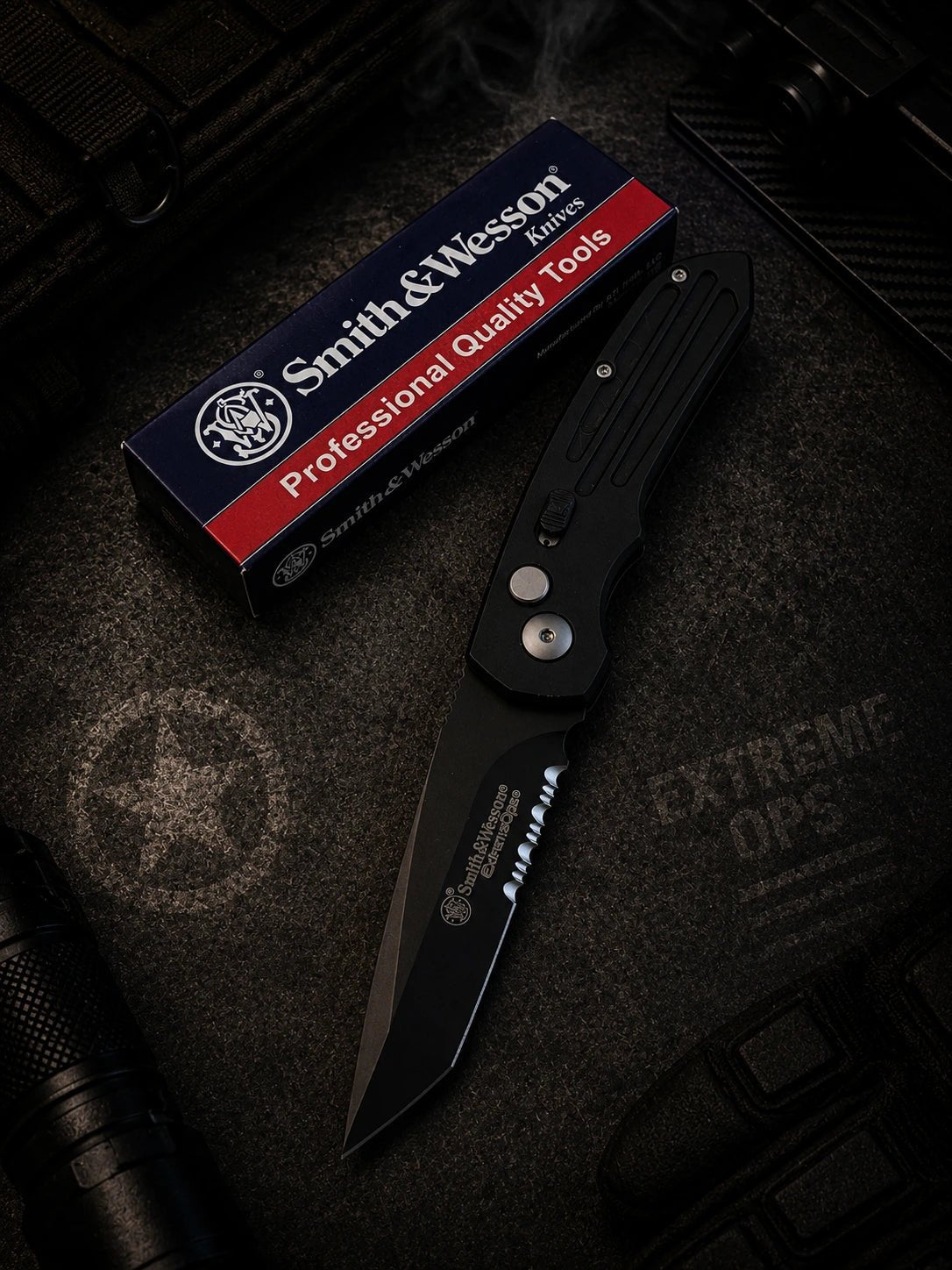
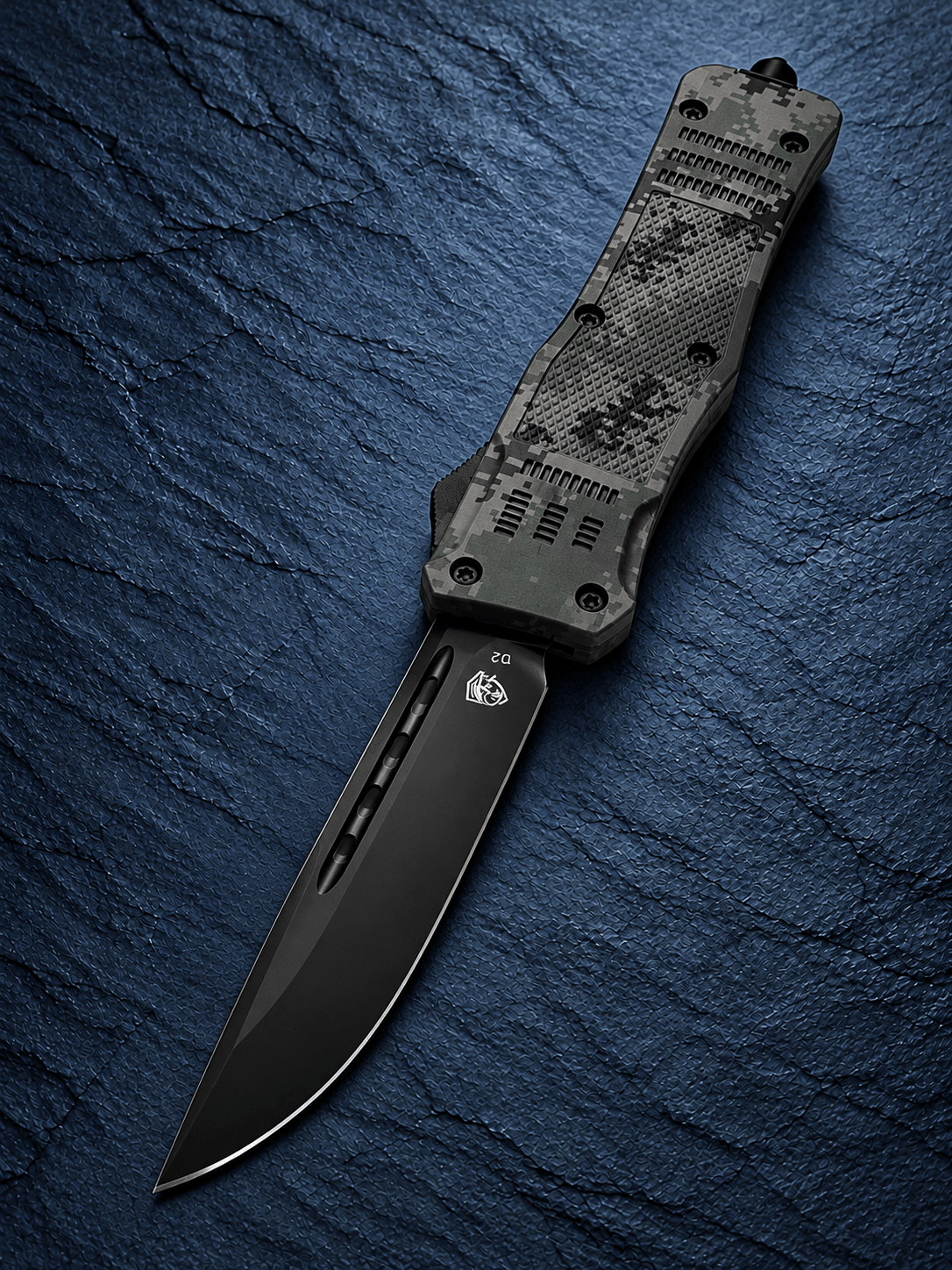
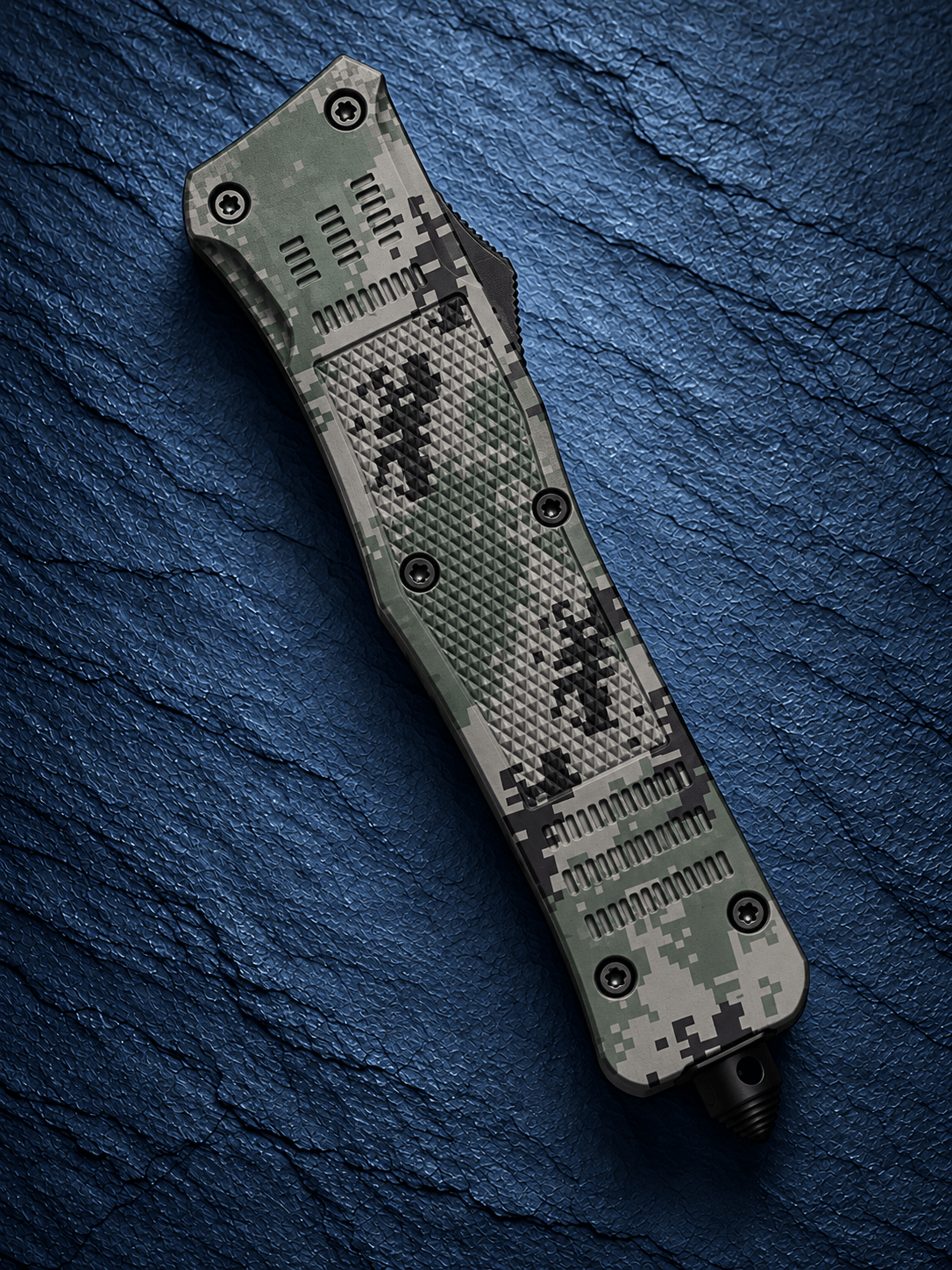
Blade Steel Guide

Knife Blade Steel Guide: D2 vs M390, M390MK, CPM S30V, 440C and 440A
Choosing the best knife steel depends on how you plan to use and maintain your knife. Some blade steels prioritize long-lasting sharpness, while others are easier to sharpen, more resistant to corrosion, tougher under impact, or more affordable.
This comprehensive knife blade steel guide compares D2, Böhler M390, M390MK, CPM S30V, 440C and 440A steel across the qualities that matter most:
- Edge retention
- Corrosion resistance
- Toughness and chip resistance
- Ease of sharpening
- Maintenance requirements
- Price and overall value
- Best applications for EDC, OTF and automatic knives
Southern Sporting Goods LLC carries OTF knives, folding automatic knives and everyday-carry models made with multiple blade steels, from dependable value-focused alloys to premium powder-metallurgy steels.
Quick Knife Steel Comparison
| Blade steel | Edge retention | Corrosion resistance | Toughness | Sharpening difficulty | Best for |
|---|---|---|---|---|---|
| D2 | Very good | Moderate | Moderate | Moderate | Hard-use EDC and value-focused knives |
| M390 | Excellent | Excellent | Moderate to good | Difficult | Premium EDC, OTF and collector knives |
| M390MK | Excellent | Excellent | High for its class | Difficult | Premium Microtech knives and demanding daily use |
| CPM S30V | Very good | Very good | Good | Moderate to difficult | Balanced premium EDC and outdoor use |
| 440C | Good | Very good | Good | Relatively easy | Reliable everyday and automatic knives |
| 440A | Moderate | Very good | Good | Easy | Affordable EDC and general utility |
These ratings are general comparisons rather than guarantees. Blade geometry, edge angle, hardness, heat treatment, manufacturing quality and intended use can significantly affect how two knives made from the same steel perform.
What Makes a Good Knife Steel?
There is no single blade steel that is best for every user. Knife steel performance is a balance among several competing properties.
Edge Retention
Edge retention describes how long a blade continues cutting effectively before it needs sharpening. Steels with greater wear resistance generally hold an edge longer, but they are often more difficult to sharpen.
M390 and M390MK are strong choices when extended cutting performance is a priority. D2 and CPM S30V also provide very good edge retention without always reaching the price level of premium M390 knives.
Corrosion Resistance
Corrosion resistance measures how well a steel resists rust, staining and damage caused by moisture, humidity, perspiration or exposure to corrosive materials.
M390, M390MK, CPM S30V, 440C and 440A are stainless steels. D2 contains a high level of chromium but is generally considered less corrosion-resistant than the stainless options in this guide. D2 should be cleaned and lightly oiled more regularly, particularly in humid or coastal environments.
Toughness
Toughness is a steel’s ability to resist cracking, breaking and chipping when it encounters impact or twisting forces. Toughness is not the same as hardness.
A very hard blade may hold an edge for a long time but can become more susceptible to chipping when used improperly. Knife blades are cutting tools and should not be used as pry bars, screwdrivers or impact tools.
Ease of Sharpening
A steel that offers exceptional wear resistance will usually require more time and better sharpening equipment. M390 and M390MK may benefit from diamond or quality ceramic sharpening systems. The more traditional 440-series steels are generally easier for the average owner to maintain.
Heat Treatment
The steel name only identifies the alloy. Heat treatment determines how the manufacturer develops that alloy’s hardness, toughness, wear resistance and corrosion performance.
A properly heat-treated 440C blade may outperform a poorly treated blade made from a more expensive alloy. Blade thickness, grind, edge geometry and production consistency also influence real-world performance.
D2 Tool Steel
What Is D2 Steel?
D2 is a high-carbon, high-chromium cold-work tool steel recognized for high hardness, wear resistance and durability. Uddeholm describes AISI D2 as a steel capable of reaching approximately 60–62 HRC after heat treatment, with excellent edge retention for cutting tools and blades.
D2 is produced through conventional steelmaking rather than the powder-metallurgy process used for M390 and CPM S30V. Its combination of performance and attainable cost has made it popular in EDC knives, OTF knives, automatic folders and larger utility blades.
Advantages of D2 Steel
Strong edge retention: D2’s high wear resistance allows it to maintain a working edge through repeated cutting.
Good value: D2 often delivers better edge retention than entry-level stainless steel without the premium cost of M390.
High hardness: Properly heat-treated D2 can support a durable, long-lasting edge.
Suitable for demanding utility work: It is a practical choice for cutting cardboard, rope, plastic straps and other abrasive materials.
Disadvantages of D2 Steel
Limited corrosion resistance: D2 resists corrosion better than many basic carbon steels, but it does not provide the same stain resistance as M390, CPM S30V or the 440-series stainless steels.
Can be more difficult to sharpen: Its wear resistance makes sharpening slower than with 440A and many 440C blades.
Moderate toughness: Conventional D2 can contain larger carbide structures than modern powder steels, potentially making thin edges more susceptible to chipping under high stress.
Best Uses for D2 Knife Steel
D2 is an excellent choice for:
- Budget and mid-priced OTF knives
- Everyday utility cutting
- Work knives
- Users who prioritize edge retention over maximum corrosion resistance
- Buyers looking for strong performance at a reasonable price
How to Care for D2 Steel
Wipe the blade dry after use and apply a small amount of knife-safe oil periodically. Additional maintenance is recommended after exposure to rain, salt air, perspiration or acidic materials.
Choose D2 if:
You want very good edge retention and hard-use performance without paying premium-steel prices.
Böhler M390 Steel
What Is M390 Steel?
Böhler M390 MICROCLEAN is a corrosion-resistant martensitic chromium steel manufactured using powder metallurgy. Böhler lists a composition containing approximately 1.9% carbon, 20% chromium, 4% vanadium, 1% molybdenum and 0.6% tungsten. The manufacturer describes it as having very high wear resistance, good corrosion resistance and high micro-cleanliness.
Powder metallurgy creates a more uniform distribution of alloying elements and carbides than conventional steelmaking. In knife blades, this helps support a combination of high wear resistance, fine-edge stability and consistent performance.
Advantages of M390 Steel
Excellent edge retention: Its high wear resistance allows a properly treated M390 blade to remain sharp through extended cutting.
Excellent corrosion resistance: M390 is one of the strongest choices in this comparison for humid environments, frequent carry and users who want reduced maintenance.
Premium performance balance: It combines long edge life, corrosion resistance and useful toughness in a single alloy.
Fine, consistent structure: Its powder-metallurgy production supports uniformity and reliable performance.
Disadvantages of M390 Steel
More difficult to sharpen: Its high wear resistance means basic sharpening stones may work slowly. Diamond stones are often the most practical choice.
Higher price: M390 material and processing costs contribute to higher knife prices.
Not designed for prying or heavy impact: Although M390 offers a strong overall balance, it is selected primarily for cutting performance rather than extreme shock resistance.
Best Uses for M390 Knife Steel
M390 is particularly well suited for:
- Premium OTF knives
- High-end automatic knives
- Everyday-carry folders
- Collector-grade knives
- Humid or coastal environments
- Users who want long edge life and minimal corrosion concerns
Southern Sporting Goods LLC features premium Microtech OTF and automatic knives that use high-performance Böhler steels and are designed for precise deployment, dependable lockup and everyday performance.
Choose M390 if:
You want premium edge retention and corrosion resistance and do not mind paying more or using advanced sharpening equipment.
M390MK Steel
What Is M390MK?
M390MK is a premium Böhler steel produced specifically for Microtech. Microtech identifies M390MK as a specially manufactured blade steel and describes it as an all-around steel combining excellent edge retention, corrosion resistance and a high level of toughness.
M390MK should not be treated simply as a different spelling for standard M390. It is a specialized steel associated with current Microtech production and is found on models such as the MSI and newer generations of Microtech OTF knives.
M390 vs M390MK
Both steels are premium, corrosion-resistant alloys intended to provide strong cutting performance. Standard M390 is widely used by multiple knife manufacturers, while M390MK was developed for Microtech.
Microtech emphasizes three primary qualities for M390MK:
- Excellent edge retention
- Strong corrosion resistance
- Improved all-around toughness and reliability
Microtech product information also states that M390MK provides lasting edge retention and corrosion resistance in demanding environments.
Because detailed performance also depends on hardness, blade geometry and heat treatment, buyers should avoid assuming that every M390MK blade will outperform every M390 blade in every test.
Advantages of M390MK Steel
Premium all-around performance: M390MK is designed to balance edge holding, corrosion resistance and toughness.
Excellent for daily carry: It provides the low-maintenance characteristics many users want from a premium EDC or OTF knife.
Microtech-specific engineering: The steel is associated with Microtech’s manufacturing and heat-treatment processes.
Long-lasting cutting edge: Microtech uses it in both premium folding knives and automatic OTF models where reliable cutting performance is a priority.
Disadvantages of M390MK Steel
Premium cost: M390MK is primarily found in higher-priced Microtech knives.
Requires suitable sharpening tools: Like standard M390, it may require diamond or ceramic abrasives and more sharpening time than 440A or 440C.
Limited brand availability: Buyers generally encounter M390MK on Microtech products rather than across the broader knife market.
Best Uses for M390MK
M390MK is a leading option for:
- Premium Microtech OTF knives
- High-end EDC knives
- Collectors
- Professional users
- Buyers who want a strong blend of edge retention, toughness and corrosion resistance
Choose M390MK if:
You want a premium Microtech knife with an advanced steel engineered for balanced, dependable performance.
CPM S30V Steel
What Is CPM S30V?
CPM S30V is a martensitic stainless steel produced using Crucible Particle Metallurgy technology. It was developed specifically for knife blades and is designed to provide a balanced combination of wear resistance, corrosion resistance and toughness.
Its powder-metallurgy structure distributes hard vanadium carbides more evenly than conventional ingot steel. This helps S30V maintain a strong cutting edge while retaining a practical level of toughness for folding knives and everyday carry.
Advantages of CPM S30V
Very good edge retention: S30V holds an edge significantly longer than many traditional stainless steels.
Strong corrosion resistance: It performs well for daily carry, outdoor use and exposure to ordinary moisture.
Balanced toughness: S30V is often selected when a manufacturer wants more toughness than extremely wear-resistant steels may provide.
Proven premium EDC performance: It has been widely used in premium production knives for years.
Disadvantages of CPM S30V
Slower to sharpen than 440-series steels: Diamond or quality ceramic abrasives can make maintenance easier.
May chip at very thin edge angles: As with most high-performance steels, edge geometry should match the intended use.
Performance varies by manufacturer: Heat treatment has a major effect on S30V’s edge stability and toughness.
Best Uses for CPM S30V
CPM S30V works well for:
- Premium everyday-carry knives
- Outdoor and camping knives
- Automatic folding knives
- General-purpose work knives
- Users seeking a balance between performance and maintainability
Choose CPM S30V if:
You want a proven premium stainless steel with very good performance in every major category and no extreme weakness.
440C Stainless Steel
What Is 440C Steel?
440C is a high-carbon chromium stainless steel developed to achieve high hardness while retaining stainless properties. Carpenter Technology reports that heat-treated 440C can reach approximately 60 HRC and identifies cutlery among its established applications.
Although modern powder steels can exceed 440C in edge retention, properly heat-treated 440C remains a dependable knife steel.
Advantages of 440C Steel
Good edge retention: Its higher carbon content gives it better wear resistance than 440A in comparable blade designs.
Very good corrosion resistance: It is a practical choice for everyday carry and humid environments.
Easier to sharpen than M390: Most users can restore its edge with conventional sharpening systems.
Established track record: 440C has been used in knives, cutlery, bearings and wear-resistant components for decades.
Good performance-to-price ratio: It provides solid stainless performance without requiring premium powder-steel pricing.
Disadvantages of 440C Steel
Lower edge retention than premium powder steels: M390, M390MK and CPM S30V generally provide longer edge life when properly heat-treated.
Quality varies: A well-treated 440C blade can perform very well, while poor heat treatment can produce disappointing results.
Less premium market perception: Some shoppers overlook 440C because it is an older alloy, even though the steel remains capable for everyday use.
Best Uses for 440C Steel
440C is a strong option for:
- Everyday-carry knives
- Automatic folding knives
- General-purpose OTF knives
- Outdoor utility
- Users who want corrosion resistance and manageable sharpening
Choose 440C if:
You want a reliable stainless steel that balances edge retention, rust resistance, affordability and easy maintenance.
440A Stainless Steel
What Is 440A Steel?
440A is a martensitic stainless steel in the 440 family. It contains less carbon than 440C, which generally results in lower maximum hardness and wear resistance but can improve toughness, corrosion resistance and sharpening ease.
440A is frequently used in affordable production knives because it can provide dependable stainless performance when properly heat-treated.
Advantages of 440A Steel
Very good corrosion resistance: It is a good option for users in humid climates or anyone who prefers a low-maintenance blade.
Easy to sharpen: A 440A blade can usually be restored quickly with ordinary sharpening equipment.
Good toughness: Its lower hardness can make the edge less prone to brittle chipping during normal utility work.
Affordable: 440A helps manufacturers offer functional knives at accessible prices.
Useful for occasional and everyday cutting: It is sufficient for opening packages, cutting cord, food preparation and routine household tasks.
Disadvantages of 440A Steel
Moderate edge retention: It generally requires more frequent sharpening than 440C, D2, CPM S30V or M390.
Performance depends heavily on heat treatment: Low-quality production can make 440A feel soft or cause the edge to roll prematurely.
Not ideal for extended abrasive cutting: Users who regularly cut large amounts of cardboard, rope or heavy synthetic material may prefer D2 or a premium powder steel.
Best Uses for 440A Steel
440A is well suited for:
- Affordable EDC knives
- Light-duty automatic knives
- General household utility
- Buyers who value easy sharpening
- Users who want a corrosion-resistant blade with simple maintenance
Choose 440A if:
You want an affordable, corrosion-resistant knife that is easy to sharpen and intended for normal everyday cutting.
D2 vs M390: Which Is Better?
M390 is the better choice for corrosion resistance, long-term edge retention and premium overall performance. D2 is the better choice for buyers who want strong edge retention at a much lower price.
Choose D2 for demanding utility work, value and acceptable maintenance.
Choose M390 for premium EDC use, humid conditions, longer edge life and reduced corrosion concerns.
M390 vs M390MK: What Is the Difference?
M390 is Böhler’s widely available powder-metallurgy stainless steel. M390MK is a specialized Böhler steel manufactured for Microtech.
Both offer premium edge retention and corrosion resistance. Microtech positions M390MK as an all-around knife steel with a high level of toughness in addition to its edge-retention and corrosion properties.
For most buyers, knife construction, blade geometry, model design and intended use will matter more than choosing between these two premium steels solely by name.
CPM S30V vs M390
M390 generally offers greater wear resistance and edge retention, while CPM S30V is often appreciated for its balanced performance and practical toughness.
Choose M390 when maximum edge life and corrosion resistance are most important.
Choose CPM S30V when you want a versatile premium steel that is slightly easier to maintain and well suited to daily or outdoor use.
440C vs 440A
The main practical difference is carbon content and the performance that follows from it.
440C generally offers:
- Greater hardness
- Better wear resistance
- Longer edge retention
- More difficult sharpening
440A generally offers:
- Easier sharpening
- Strong corrosion resistance
- Good toughness
- Lower cost
- More frequent edge maintenance
Choose 440C for better cutting longevity. Choose 440A for affordability, low maintenance and quick sharpening.
What Is the Best Blade Steel for an OTF Knife?
The best OTF knife steel depends on your budget and intended use.
Best Premium OTF Knife Steel
M390 or M390MK
These steels are ideal for buyers who want premium corrosion resistance, strong edge retention and high-end materials. M390MK is particularly relevant when shopping for current Microtech OTF knives.
Best Value OTF Knife Steel
D2
D2 delivers strong wear resistance and edge retention without the price of premium powder steel. It requires more attention to corrosion prevention.
Best Balanced OTF Knife Steel
CPM S30V or 440C
Both offer practical stainless performance. S30V belongs to the premium category, while 440C is typically more affordable and easier to sharpen.
Best Budget and Easy-Maintenance Steel
440A
It is appropriate for routine cutting, occasional carry and buyers who prefer a blade that can be sharpened quickly.
How to Choose the Right Knife Steel
Choose M390 or M390MK when:
- You want premium performance
- Long edge retention is a top priority
- You carry in humid or wet environments
- You do not mind using diamond sharpening equipment
- You are purchasing a premium Microtech, automatic or OTF knife
Choose CPM S30V when:
- You want a balanced premium steel
- You need strong edge retention and corrosion resistance
- You use your knife for EDC and outdoor tasks
- You want premium performance without prioritizing maximum wear resistance
Choose D2 when:
- You want excellent value
- You cut cardboard, rope and abrasive materials
- You are willing to clean and oil the blade
- You prefer edge retention over easy sharpening
Choose 440C when:
- You want dependable stainless performance
- You prefer easier sharpening than M390
- You need a practical EDC or automatic knife
- You want a balance of cost, edge retention and corrosion resistance
Choose 440A when:
- Affordability matters
- Your knife will handle normal daily tasks
- You want strong corrosion resistance
- You prefer fast, easy sharpening
- You do not mind touching up the edge more frequently
Blade Steel Frequently Asked Questions
What is the best knife steel overall?
There is no universal best knife steel. M390 and M390MK are excellent premium choices for edge retention and corrosion resistance, while CPM S30V provides balanced performance. D2 offers excellent value, 440C is a dependable all-around stainless steel, and 440A is affordable and easy to sharpen.
Which knife steel stays sharp the longest?
Among the steels covered here, properly heat-treated M390 and M390MK generally provide the longest edge retention. CPM S30V and D2 also perform very well.
Which blade steel is easiest to sharpen?
440A is generally the easiest to sharpen, followed by 440C. D2 and CPM S30V require more effort, while M390 and M390MK usually benefit from diamond or ceramic sharpening systems.
Which steel is most resistant to rust?
M390 and M390MK offer excellent corrosion resistance. CPM S30V, 440C and 440A are also strong stainless choices. D2 requires the most corrosion-prevention care of the steels compared in this guide.
Is D2 considered stainless steel?
D2 contains substantial chromium, but not all of that chromium remains available to resist corrosion because some is tied up in carbides. It is commonly described as semi-stainless or a corrosion-resistant tool steel rather than a fully stainless knife steel.
Is 440C still a good knife steel?
Yes. Properly heat-treated 440C offers good edge retention, corrosion resistance and sharpening ease. It remains a practical material for EDC, automatic and utility knives despite being older than today’s powder-metallurgy steels.
Is 440A a low-quality steel?
Not necessarily. 440A prioritizes corrosion resistance, toughness, sharpening ease and affordability rather than maximum edge retention. Its performance depends heavily on heat treatment and manufacturing quality.
Does blade coating prevent rust?
A blade coating can reduce direct exposure to moisture, but the cutting edge and any scratched areas remain exposed. Every knife should still be cleaned and dried after use.
Does harder steel always mean a better knife?
No. Greater hardness can improve edge retention but may reduce toughness or make sharpening more difficult. The best hardness depends on the steel, heat treatment, blade shape and intended use.
Find the Right Knife for Your Needs
Whether you are comparing a budget D2 OTF knife, a stainless 440C automatic, or a premium Microtech built with M390 or M390MK steel, the best choice is the knife that matches your cutting needs, maintenance preferences and budget.
Southern Sporting Goods LLC offers OTF knives, automatic folding knives, switchblade knives and premium Microtech models, with free U.S. shipping, 30-day returns and discreet packaging.
Explore More Models